Why do silicone emulsion defoamers undergo emulsion breaking? What are the causes?
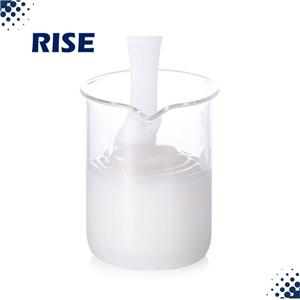
Silicone emulsion defoamers are widely used in sectors such as papermaking, water treatment, oilfield operations, water-based coatings, adhesives, and industrial cleaning. Users often encounter issues where the defoamer performs excellently upon initial addition but suffers from oil separation or stratification after sitting for a period, or suddenly loses stability when introduced into certain systems. Further analysis reveals that these phenomena are frequently linked to "demulsification."
However, there is a common misconception that demulsification in silicone emulsion defoamers indicates poor product quality or an unstable emulsification system. In reality, the design of these defoamers involves an inherent contradiction: they must remain stable during storage yet release active silicone oil during use to effectively suppress foam. Therefore, the goal is not absolute stability, but rather striking a balance between stability and the release of active ingredients.
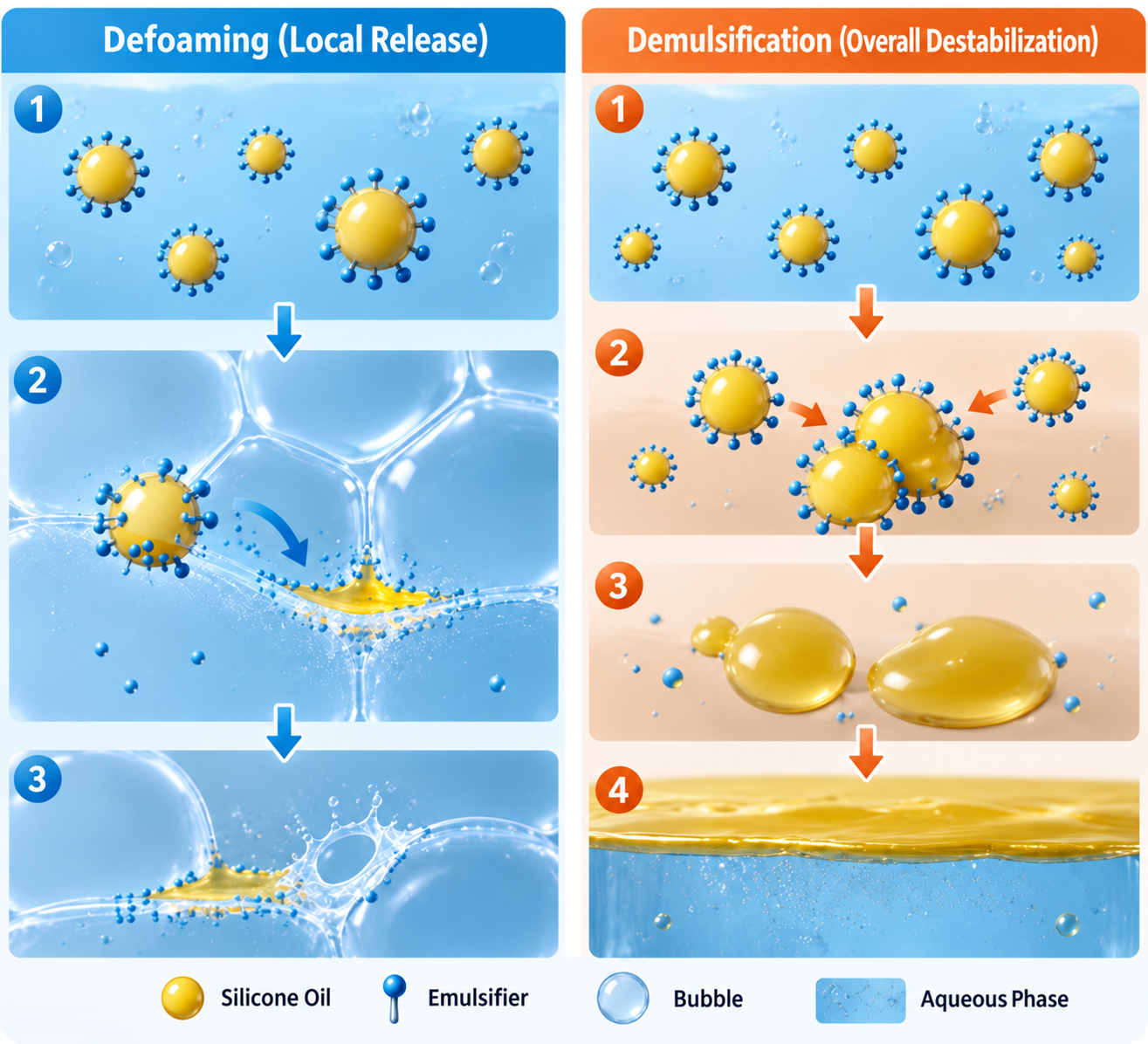
Primary Causes of Demulsification in Silicone Emulsion Defoamers
The fundamental cause of demulsification in silicone emulsion defoamers is the failure of the protective layer at the oil-water interface. Emulsifiers typically adsorb at the interface between silicone oil and water, forming a protective film that prevents silicone oil droplets from coming into contact with one another; when this interfacial film is compromised, the droplets are prone to coalescence.
One common factor is the influence of electrolytes. For instance, the presence of significant amounts of salts—particularly multivalent ions such as calcium and magnesium—weakens the repulsive forces between emulsion droplets, making it easier for them to approach and merge. Another significant factor is the influence of other surfactants present in the system. Many industrial systems inherently contain components such as dispersants, emulsifiers, and wetting agents.
Upon the addition of the silicone emulsion defoamer, these substances may compete with the defoamer's emulsifiers for adsorption sites, altering the stability of the silicone oil droplet interface and leading to destabilization. Temperature fluctuations also play a critical role in demulsification. For non-ionic emulsifiers, rising temperatures can cause the dehydration of polyoxyethylene segments, thereby reducing the emulsifier's hydrophilicity and interfacial protective capacity, ultimately compromising the emulsion's stability. Additionally, changes in pH, high-shear forces, and the presence of polymer components within the system can also alter the interfacial structure of the emulsion.
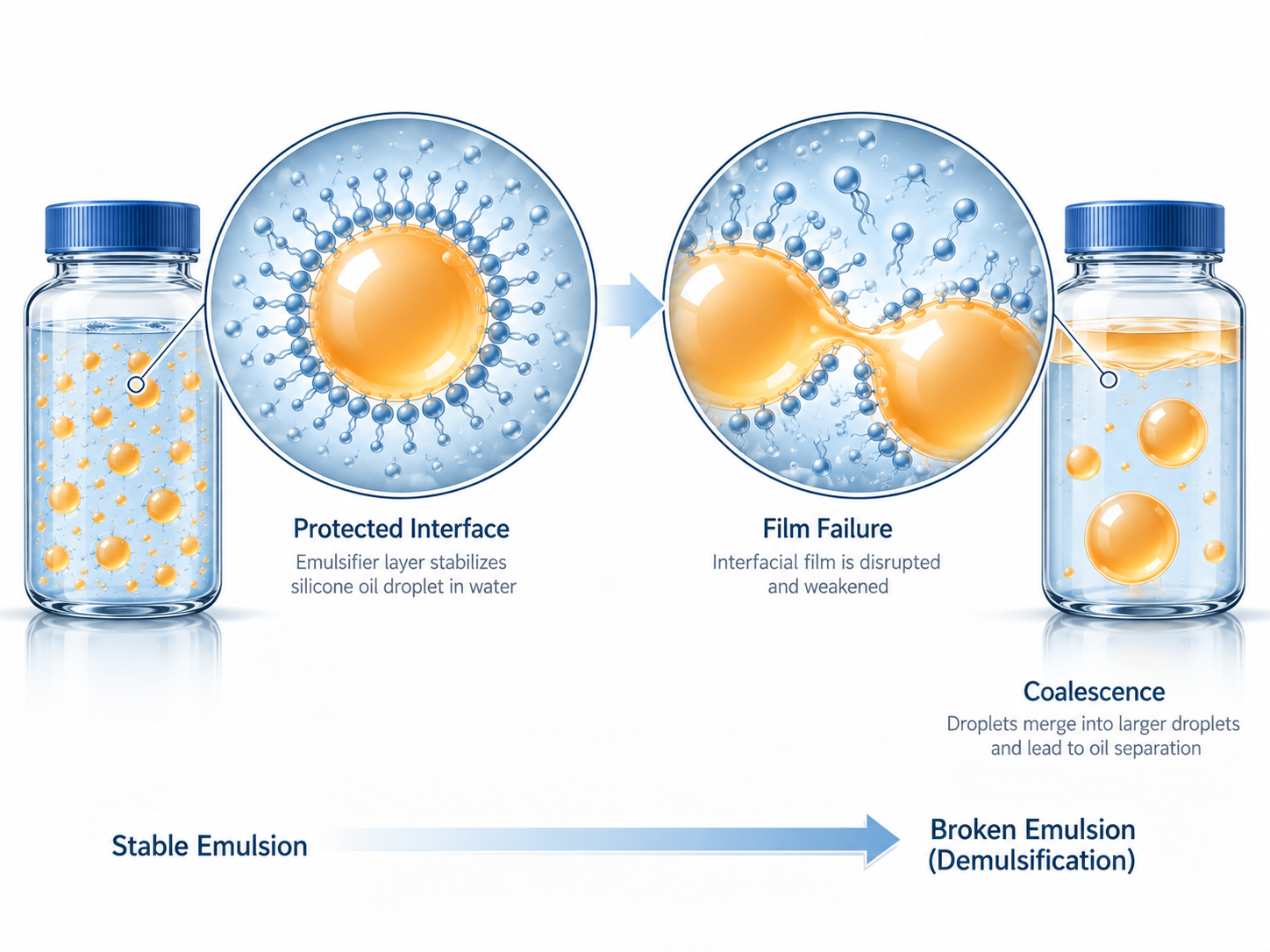
The issue of emulsion breaking in silicone emulsion defoamers essentially reflects the inherent conflict between emulsion stability and defoaming activity. While silicone emulsion defoamers require a certain degree of demulsification to function, this release must be kept within a reasonable range. An excellent silicone emulsion defoamer is neither the most stable product nor the one that breaks most easily; rather, it is one that strikes the optimal balance between "stable storage" and "rapid release." Understanding this explains why the same defoamer can perform vastly differently in different systems, and why the selection and design of a defoamer must take the specific application environment into account.