What are the common methods for adding defoamers
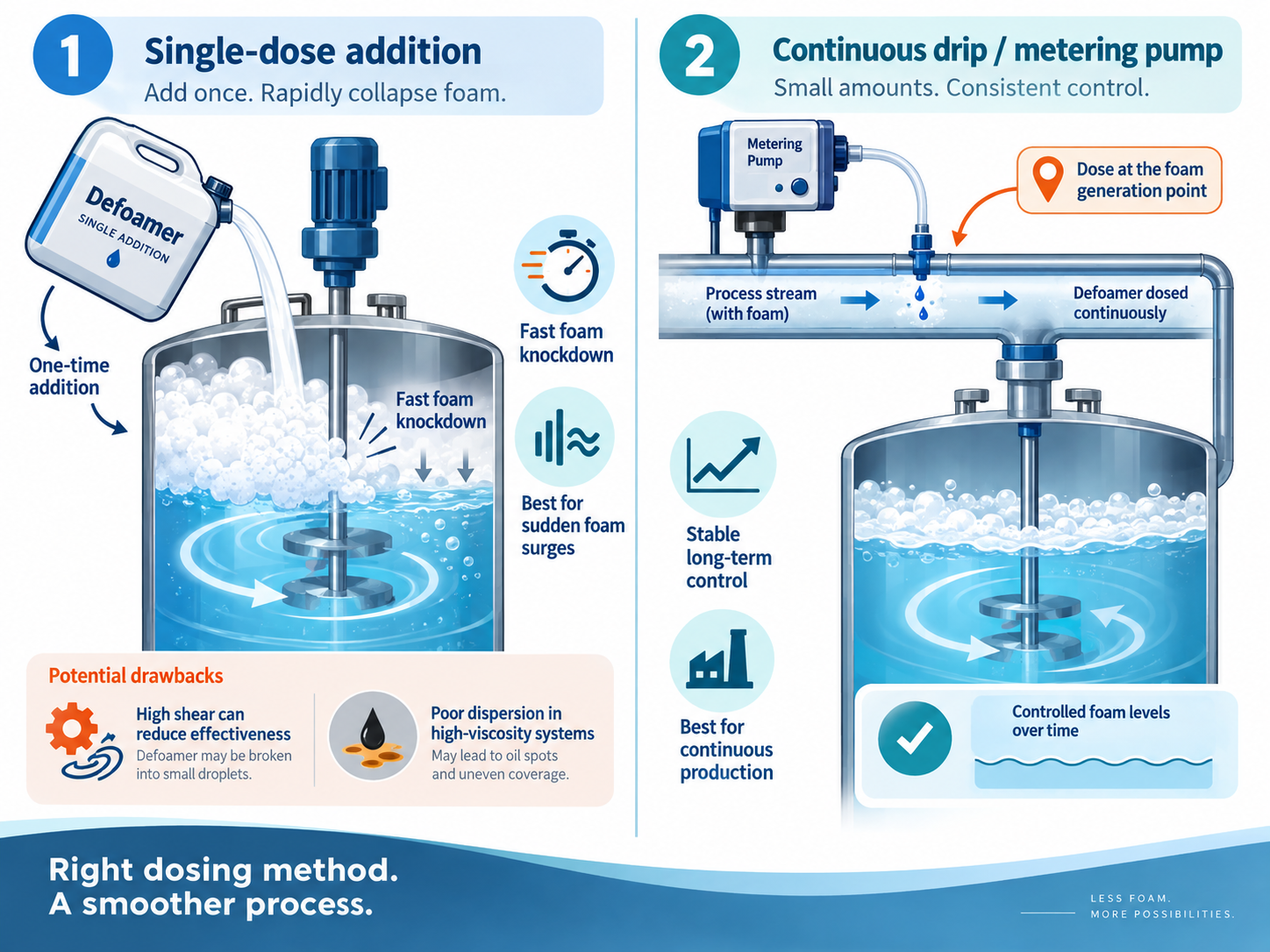
1. SINGLE-DOSE ADDITION (DIRECT ADDITION OF DEFOAMER)
Pour the defoamer directly into the foaming system in a single dose and stir until evenly dispersed.
• Suitable for: Systems experiencing sudden foam surges or significant foam accumulation; batch production processes.
• Advantages: Simple operation; rapid foam suppression and breakdown.
• Disadvantages: Under high-shear conditions, the defoamer may break down, reducing its effective lifespan; in high-viscosity systems, poor dispersion can lead to oil spots or surface oil films.
2. CONTINUOUS DRIP / METERING PUMP DOSING OF DEFOAMER
Use a metering pump to slowly and continuously drip the defoamer into the foaming liquid stream based on the flow rate.
• Suitable for: Continuous production lines (wastewater treatment, coating lines, continuous discharge from chemical reactors).
• Advantages: Controllable dosage, stable defoaming performance, reduced localized excess surface oil, and effective long-term foam suppression.
• Note: Select the point of foam generation for dosing; do not simply drip it into a static pool.
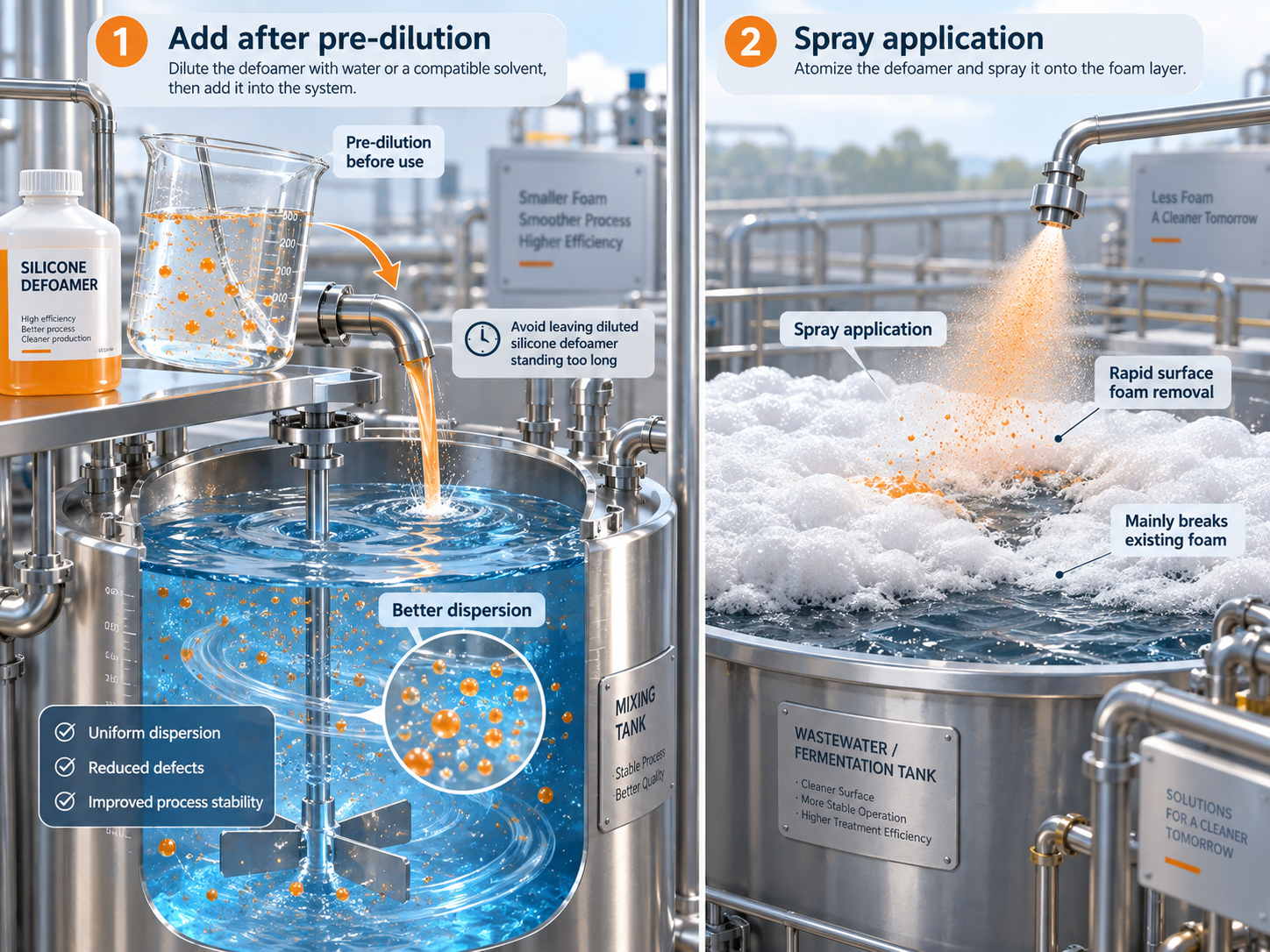
3. ADD THE DEFOAMER AFTER PRE-DILUTION
Pre-dilute the defoamer with water or a system-compatible solvent before adding it to the system. (Note: Many silicone-based defoamers should not be diluted and left to sit for extended periods; they should be prepared immediately before use and consumed quickly after dilution to avoid emulsion breakdown and loss of effectiveness.)
• Suitable for: High-viscosity neat products that are difficult to disperse; low-solids systems.
• Advantages: Ensures more uniform dispersion and prevents localized high concentrations that could cause defects such as fish-eyes (craters) or oil spots.
4. PREMIXING DEFOAMERS (PRIMARILY POWDER TYPES) INTO THE MASTERBATCH
Powder defoamers are first mixed directly with the dry raw materials before water is added to prepare the solution.
• Applications: Dry powder systems, such as putty, cement, powder coatings, and powdered detergents.
• Advantages: Ensures uniform dispersion, prevents clumping, and provides simultaneous defoaming action when the mixture comes into contact with water.
5. SPRAY APPLICATION OF DEFOAMER
Dilute the defoamer, atomize it, and spray it directly onto the surface of the foam layer.
• Suitable for: Thick surface foam layers, as well as foam on the surface of sewage tanks or fermentation tanks.
• Advantages: Rapidly eliminates surface foam using only a small amount; does not significantly mix into the underlying liquid medium.
• Disadvantages: Weak ability to suppress foam generated within the liquid; primarily effective for breaking existing foam rather than preventing foam formation.
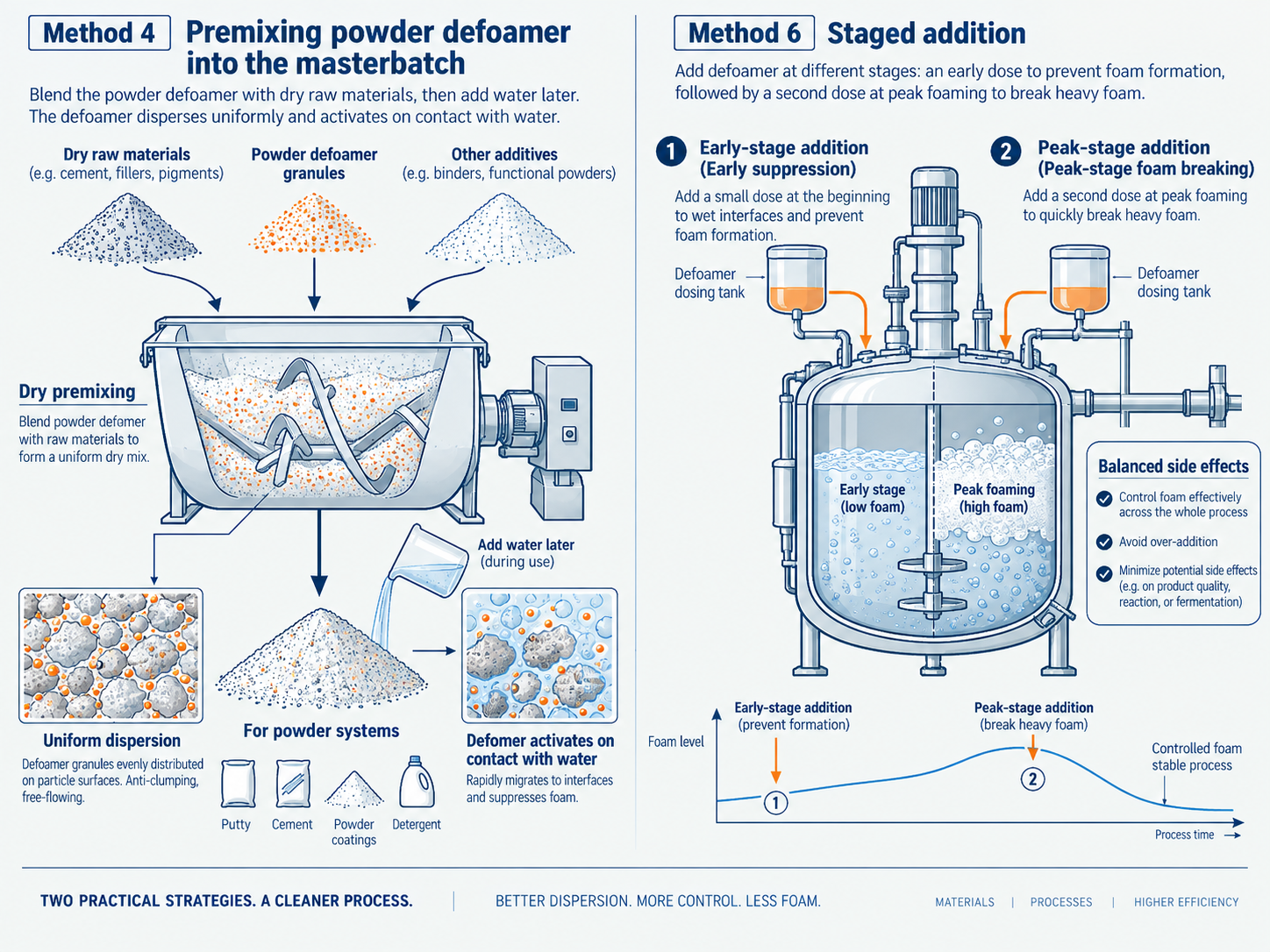
6. STAGED ADDITION OF DEFOAMER
Add a portion early in the reaction to suppress foam formation, and add another portion during the peak foaming stage.
• Suitable for: Chemical synthesis and fermentation processes where foaming increases gradually.
• Advantages: Balances early-stage foam suppression with peak-stage foam breaking, while minimizing side effects associated with adding a large amount of defoamer all at once.
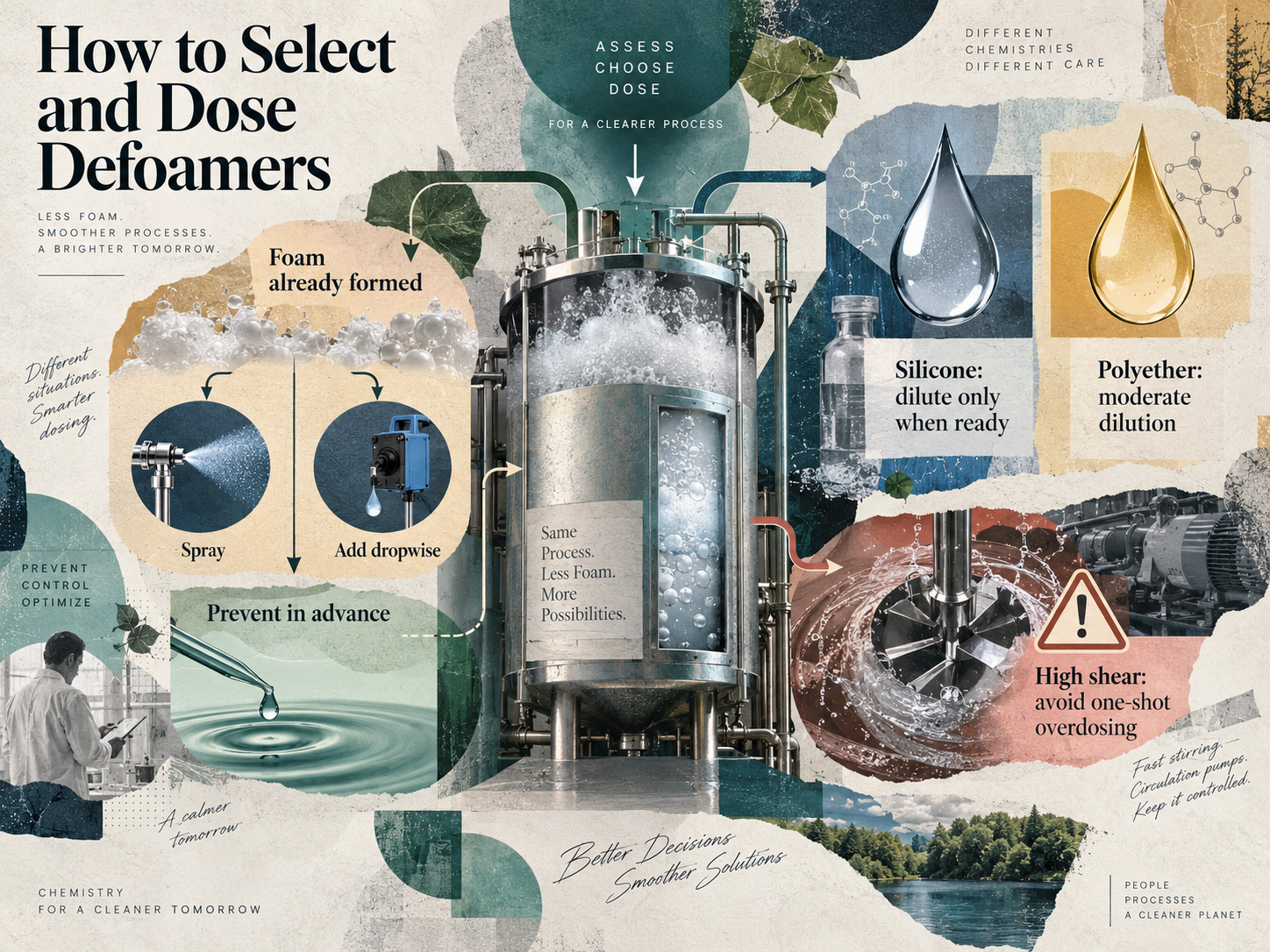
How should you select and dose defoamers?
1. If foam has already formed: Prioritize dropwise addition or spraying. To prevent foam before it appears: Dose in advance to inhibit foam formation.
2. Silicone-based defoamers: Minimize prolonged pre-dilution; dilute only when ready for use. Polyether-based defoamers: Can be moderately diluted.
3. High-shear environments (e.g., high-speed stirring, circulation pumps): Avoid adding large doses all at once, as this can cause emulsion breakdown and loss of effectiveness.
CONTACT US to discuss your industry and specific operating conditions; RISE CHEMICAL will provide the ideal foam cont.