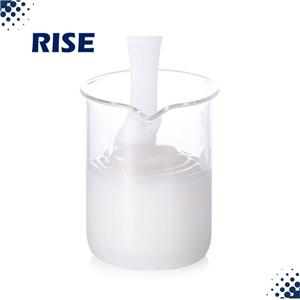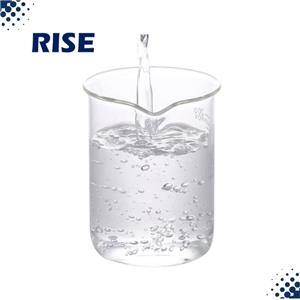
Not sure how to choose a defoamer for wastewater treatment Just remember these points.
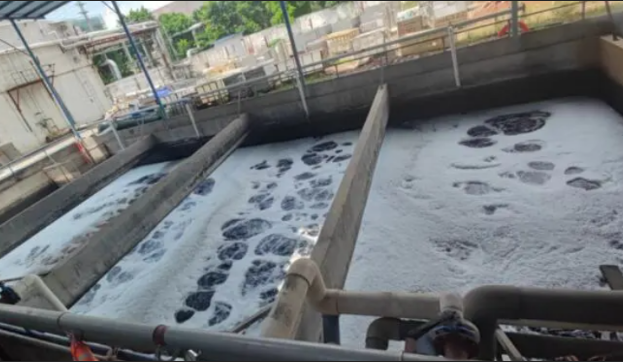
Excessive foaming is a common problem encountered by many people in the process of biological wastewater treatment. Continuous foaming in aeration tanks and aerobic tanks not only affects the efficiency of wastewater treatment, but also easily leads to problems such as foam overflow, site mess, and substandard water quality.
Foam in water treatment mainly comes from two sources. One type is chemical foam: surfactants and organic matter in the influent form a stable and resistant gas-liquid interface under aeration shear. The other type is biological foam: produced when filamentous bacteria and other microorganisms proliferate excessively, often appearing in combination with the former. Therefore, simply reducing air volume or adjusting load often only addresses the symptoms, not the root cause.
However, many people easily make mistakes when choosing defoamers for wastewater treatment. Choosing the wrong defoamer not only fails to solve the foam problem but can also affect the operation of the entire biological treatment system. The working logic of wastewater treatment defoamers involves two steps: foam breaking and foam suppression. Foam breaking quickly breaks existing foam films, while foam suppression continuously prevents the formation of new foam within the system. Ideally, both should be achieved; if only the foam is broken quickly or only the foam is suppressed, repeated additions are likely to occur.

In fact, choosing a wastewater treatment defoamer doesn't have to be complicated. Just remember the following key points, and you'll choose the right one and avoid problems!
Key Point 1 — Wastewater treatment defoamers must ensure that the operating environment does not affect the biochemical bacteria strains.
Microbial strains are the core of a biological treatment system, and this is crucial for achieving wastewater treatment standards. Many common wastewater treatment defoamers are highly toxic, inhibiting microbial activity and causing serious problems such as microbial death, system failure, and excessive effluent quality.
For core biological treatment tanks such as aeration tanks and aerobic tanks, polyether defoamers and modified silicone polyether defoamers are recommended. These wastewater treatment defoamers are mild, do not inhibit microbial activity, are perfectly compatible with various biological wastewater treatment systems, and are safe and reliable to use.
Key point two — Focus on cost-effectiveness, eliminating the need for frequent replenishment of wastewater treatment defoamer.
In wastewater treatment, additive costs are a long-term expense. When selecting a wastewater treatment defoamer, one should not only consider the unit price, but also the overall cost-effectiveness.
Prefer wastewater treatment defoamers that require low dosage, provide rapid defoaming and long-lasting foam suppression, eliminating the need for frequent top-ups. Long-term use can effectively reduce wastewater treatment costs in the plant, saving both time and money.
Key Point 3 — Different operating conditions necessitate the selection of appropriate wastewater treatment defoamers.
While general-purpose defoamers can be used for normal water quality, they should never be used blindly for particularly harsh water conditions!
For wastewater environments with high salinity, high acidity/alkalinity, or high oil content, ordinary defoamers are prone to failure, incomplete defoaming, and repeated foaming. In such cases, it is essential to use a specialized, customized wastewater treatment defoamer. This ensures stable defoaming, long-lasting foam suppression, and suitability for harsh wastewater conditions. The key to selecting a wastewater defoamer is its suitability! Ensuring the safety of microbial strains, controlling costs, and choosing the right product for your specific needs will easily solve wastewater foam problems.