Foam Overflow Alert! Key Points for Selecting Water Treatment Antifoam
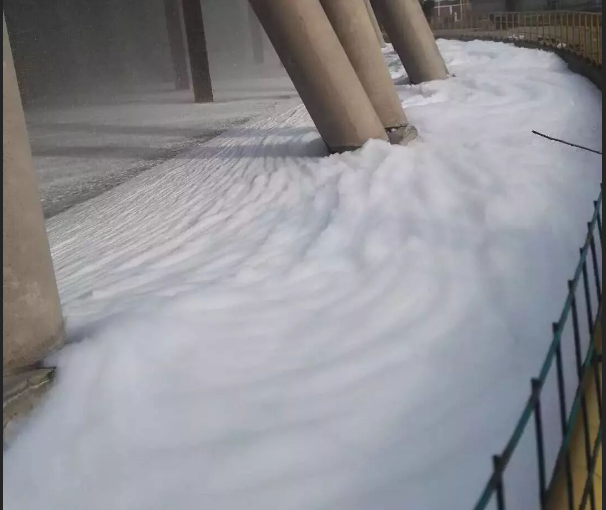
During the operation of a cooling tower, the occasional appearance of small amounts of foam that dissipate quickly is usually associated with water turbulence and air entrainment. However, if the foam suddenly increases, persists for a long time, or is accompanied by the water turning green, developing an odor, or accumulating slime, the situation cannot be dismissed as a routine occurrence. Excessive foaming often indicates abnormalities regarding microorganisms, organic matter, chemical concentrations, or operating conditions within the circulating water system, requiring timely investigation and remediation.
The causes of foaming in circulating cooling water primarily stem from three factors. First is the accumulation of surface-active substances in the water, including decomposition products of added corrosion and scale inhibitors, leaked process materials, and extracellular polymeric substances produced by microbial metabolism. Second is the introduction of large amounts of air during aeration and spraying processes; the breakup of water droplets within the cooling tower's fill layer is, in itself, a process of air entrainment. Third, the rise in water temperature reduces the water's surface tension, thereby stabilizing the foam.
Selecting an antifoam for circulating cooling water systems involves specific considerations. These systems typically operate under mildly alkaline conditions (pH 7.5–9.0) with water temperatures ranging from 30°C to 45°C; consequently, the antifoam must exhibit good thermal and chemical stability without interfering with the performance of corrosion and scale inhibitors. Silicone-based antifoams are widely used in these systems due to their rapid defoaming action and low dosage requirements; however, in systems sensitive to silica scaling, polyether or modified polyether antifoams may be a safer choice.
Defoaming mechanisms of antifoam
Reduction of local surface tension causes foam collapse.
Promotion of liquid film drainage leads to bubble rupture.
Solubilization of foam-stabilizing surfactants can cause bubble rupture.
Disruption of film elasticity leads to bubble rupture.
Common types of defoamers
Silicone-based defoamers
Polyether-based defoamers
Mineral oil-based defoamers
Dosage of antifoam
Alcohol-based antifoam: The dosage is generally within the range of 0.01–0.10%.
Oil/fat-based antifoam: The dosage for oil/fat-based defoamers is between 0.05% and 2%, while for fatty acid ester antifoam, it is between 0.002% and 0.2%.
Amide-based antifoam: These are highly effective, with a typical dosage within the range of 0.002–0.005%.
Phosphate-based antifoam: Most commonly used in fibers and lubricating oils, with a dosage between 0.025% and 0.25%.
Amine-based antifoam: Primarily used in fiber processing, with a dosage of 0.02–2%.
Ether-based antifoam: Widely used in papermaking, printing and dyeing, and cleaning processes; the dosage is generally 0.025–0.25%.
Please feel free to contact us with any questions or concerns regarding antifoam; with 20 years of R&D experience, we help make your production more efficient. Contact us to request free samples!